Step 6. Bundle cleaning
Some streamlines within the corridor follow atypical trajectories. Cleaning is performed with clean_bundle from pyAFQ (Kruper et al., 2021), which implements the procedure of Yeatman et al. (2012): each streamline is resampled to 100 points, its Mahalanobis distance from the bundle's mean trajectory is computed, and streamlines exceeding a distance threshold or a length threshold are removed iteratively (Table 1).
Procedure
Table 1
Cleaning Parameters
| Parameter | Value | Meaning |
|---|---|---|
n_points | 100 | Resampling prior to comparison. |
clean_rounds | 5 | Maximum iterations; stops earlier when no streamlines are removed. |
distance_threshold | 3 | Streamlines more than 3 SD (Mahalanobis) from the bundle centroid are removed. |
length_threshold | 2 | Streamlines longer than the mean length by more than 2 SD are removed. |
stat | mean | Centroid statistic. |
core_only | 0 | Distance is computed over the full length of each streamline. pyAFQ 3 and later default to the middle 60%; the script sets 0 so that results do not depend on the installed version. |
from AFQ.recognition.cleaning import clean_bundle
cleaned, keep = clean_bundle(sft, n_points=100, clean_rounds=5,
                             distance_threshold=3, length_threshold=2,
                             stat="mean", core_only=0, return_idx=True)
The core_only argument exists in pyAFQ 3 and later; the script omits it under earlier versions, whose behaviour it reproduces. In pyAFQ 1.3.2 and earlier the function is imported from AFQ.segmentation; the script tries both locations.
The full script follows. It requires pyAFQ and DIPY; on older systems pip may require the zipp package to be upgraded first.
Script 06_clean_bundles.py (141 lines)
#!/usr/bin/env python3
"""Step 6. Clean each participant's raw corridor tractogram with pyAFQ, then rebuild the
covariate table (streamline count and mean length of every cleaned bundle).
Inputs:  $OUT/<subj>/tckgen/<TRACT>/<TRACT>_<CUTOFF>.tck      raw tractogram from Step 5
         $PROJECT/dwi/<subj>/nodif_brain_mask.nii.gz           reference grid for the .tck
         $SUBJECTS_FILE                                        one participant ID per line
Outputs: $OUT/<subj>/tckgen/<TRACT>/<TRACT>_<CUTOFF>_cleaned.tck
         $OUT/nodewise/<TRACT>_tract_stats.csv
Run:     source 00_config.sh && python 06_clean_bundles.py
         FORCE=1 in the shell redoes participants whose cleaned bundle already exists.
"""
import inspect   # used once, to ask the installed clean_bundle whether it takes core_only
import os
import sys
from pathlib import Path

import pandas as pd
# clean_bundle moved between pyAFQ releases; try the current location, then the old one.
try:
    from AFQ.recognition.cleaning import clean_bundle
except ImportError:                       # pyAFQ 1.3.2 and earlier
    from AFQ.segmentation import clean_bundle
from dipy.io.stateful_tractogram import StatefulTractogram
from dipy.io.streamline import load_tractogram, save_tractogram
from dipy.segment.clustering import QuickBundles
from dipy.segment.featurespeed import ResampleFeature
from dipy.segment.metricspeed import AveragePointwiseEuclideanMetric
from dipy.tracking.streamline import length   # per-streamline length, for the table


# One variable exported by 00_config.sh, or stop with a pointer to source it.
def env(name):
    if name not in os.environ:
        sys.exit(f"{name} is not set: run `source 00_config.sh` first")
    return os.environ[name]


# --- Settings from 00_config.sh ---
PROJECT = Path(env("PROJECT"))
OUT = Path(env("OUT"))
TRACT = env("TRACT")
CUTOFF = env("CUTOFF")   # stays a string; it is only ever used in file names
FORCE = os.environ.get("FORCE", "0") == "1"
SUBJECTS = Path(env("SUBJECTS_FILE")).read_text().split()

# --- Cleaning thresholds (Table 1 on the Step 6 page; not in 00_config.sh) ---
N_POINTS = 100          # resampling for the Mahalanobis distance
CLEAN_ROUNDS = 5        # maximum cleaning iterations
DISTANCE_SD = 3         # Mahalanobis distance threshold, SD
LENGTH_SD = 2           # length threshold, SD above the mean
QB_SPLIT = False        # True: split into two bundles before cleaning
QB_THRESHOLD_MM = 5.0   # QuickBundles distance threshold


CLEAN_ARGS = dict(n_points=N_POINTS, clean_rounds=CLEAN_ROUNDS, stat="mean",
                  distance_threshold=DISTANCE_SD, length_threshold=LENGTH_SD)
# pyAFQ 3+ measures the distance over the middle 60% of each streamline by default;
# core_only=0 restores the full-length computation; pass it only if this pyAFQ knows it.
if "core_only" in inspect.signature(clean_bundle).parameters:
    CLEAN_ARGS["core_only"] = 0


# Clean one tractogram.  We rebuild the result from the kept indices rather than use the
# copy pyAFQ returns, so the output stays in the input's space under every pyAFQ version.
def clean(sft):
    _, keep = clean_bundle(sft, return_idx=True, **CLEAN_ARGS)
    return StatefulTractogram.from_sft(sft.streamlines[keep], sft)


# Load a .tck on the participant's brain-mask grid (a .tck carries no image grid of its own).
# bbox_valid_check=False: do not refuse a streamline that grazes the volume edge.
def load(tck, reference):
    return load_tractogram(str(tck), str(reference), bbox_valid_check=False)


# --- Pass 1: clean every participant that still needs it ---
for s in SUBJECTS:
    tdir = OUT / s / "tckgen" / TRACT
    raw = tdir / f"{TRACT}_{CUTOFF}.tck"
    out = tdir / f"{TRACT}_{CUTOFF}_cleaned.tck"
    reference = PROJECT / "dwi" / s / "nodif_brain_mask.nii.gz"

    # Step 5 renames its output at the end, so a raw file at this path is always complete.
    if not raw.exists():
        print(f"[{s}] SKIP: no tractogram from Step 5")
        continue
    if out.exists() and not FORCE:
        print(f"[{s}] cleaned bundle exists")
        continue
    sft = load(raw, reference)
    n_raw = len(sft.streamlines)
    if n_raw == 0:
        print(f"[{s}] SKIP: 0 streamlines")
        continue

    if not QB_SPLIT:
        cleaned = clean(sft)
        save_tractogram(cleaned, str(out), bbox_valid_check=False)
        n_clean = len(cleaned.streamlines)
        print(f"[{s}] {n_raw} -> {n_clean} streamlines ({100 * n_clean / n_raw:.0f}% retained)")
        continue

    # Two-bundle path: cluster with QuickBundles and clean the two largest clusters separately.
    metric = AveragePointwiseEuclideanMetric(ResampleFeature(nb_points=N_POINTS))
    clusters = QuickBundles(threshold=QB_THRESHOLD_MM, metric=metric).cluster(sft.streamlines)
    largest = sorted(clusters, key=len, reverse=True)[:2]
    for i, cluster in enumerate(largest, start=1):
        part = StatefulTractogram.from_sft(sft.streamlines[cluster.indices], sft)
        cleaned = clean(part)
        name = f"{TRACT}_{CUTOFF}_cluster{i}_cleaned.tck"
        save_tractogram(cleaned, str(tdir / name), bbox_valid_check=False)
        print(f"[{s}] cluster {i}: {len(cluster)} -> {len(cleaned.streamlines)} streamlines")
    # Nothing goes to _cleaned.tck here: copy the right cluster to it by hand, then rerun.
    print(f"[{s}] inspect both clusters; copy the correct one to {out.name}")

# --- Pass 2: covariate table from the cleaned bundles (rebuilt every run) ---
# A separate loop so the table also covers participants skipped above or copied in by hand.
rows = []
for s in SUBJECTS:
    tdir = OUT / s / "tckgen" / TRACT
    raw = tdir / f"{TRACT}_{CUTOFF}.tck"
    out = tdir / f"{TRACT}_{CUTOFF}_cleaned.tck"
    if not out.exists():
        continue
    reference = PROJECT / "dwi" / s / "nodif_brain_mask.nii.gz"
    lengths = length(load(out, reference).streamlines)
    n_raw = len(load(raw, reference).streamlines) if raw.exists() else float("nan")
    # Streamline_count and Mean_length_mm feed the Step 9 models; the other two are QC only.
    rows.append({
        "Subject": s,
        "Streamline_count": len(lengths),
        "Mean_length_mm": round(float(lengths.mean()), 3) if len(lengths) else float("nan"),
        "Count_uncleaned": n_raw,
        "Retention_pct": round(100 * len(lengths) / n_raw, 1) if n_raw else float("nan"),
    })

table = OUT / "nodewise" / f"{TRACT}_tract_stats.csv"
table.parent.mkdir(parents=True, exist_ok=True)
pd.DataFrame(rows).to_csv(table, index=False)
print(f"\n{len(rows)} of {len(SUBJECTS)} participants have a cleaned bundle")
print(f"covariate table -> {table}")
Retention
With the thresholds in Table 1, cleaning typically retains 25% to 60% of streamlines, several hundred per participant. Figures 1 and 2 present the comparison referred to in Step 4: the cleaned 0.01 bundle is more compact than the uncleaned 0.06 bundle, with length standard deviations of approximately 3.5 to 4.5 mm for cleaned bundles against 5 to 7 mm for either uncleaned condition.
Figure 1
Effect of Cutoff and Cleaning on One Bundle
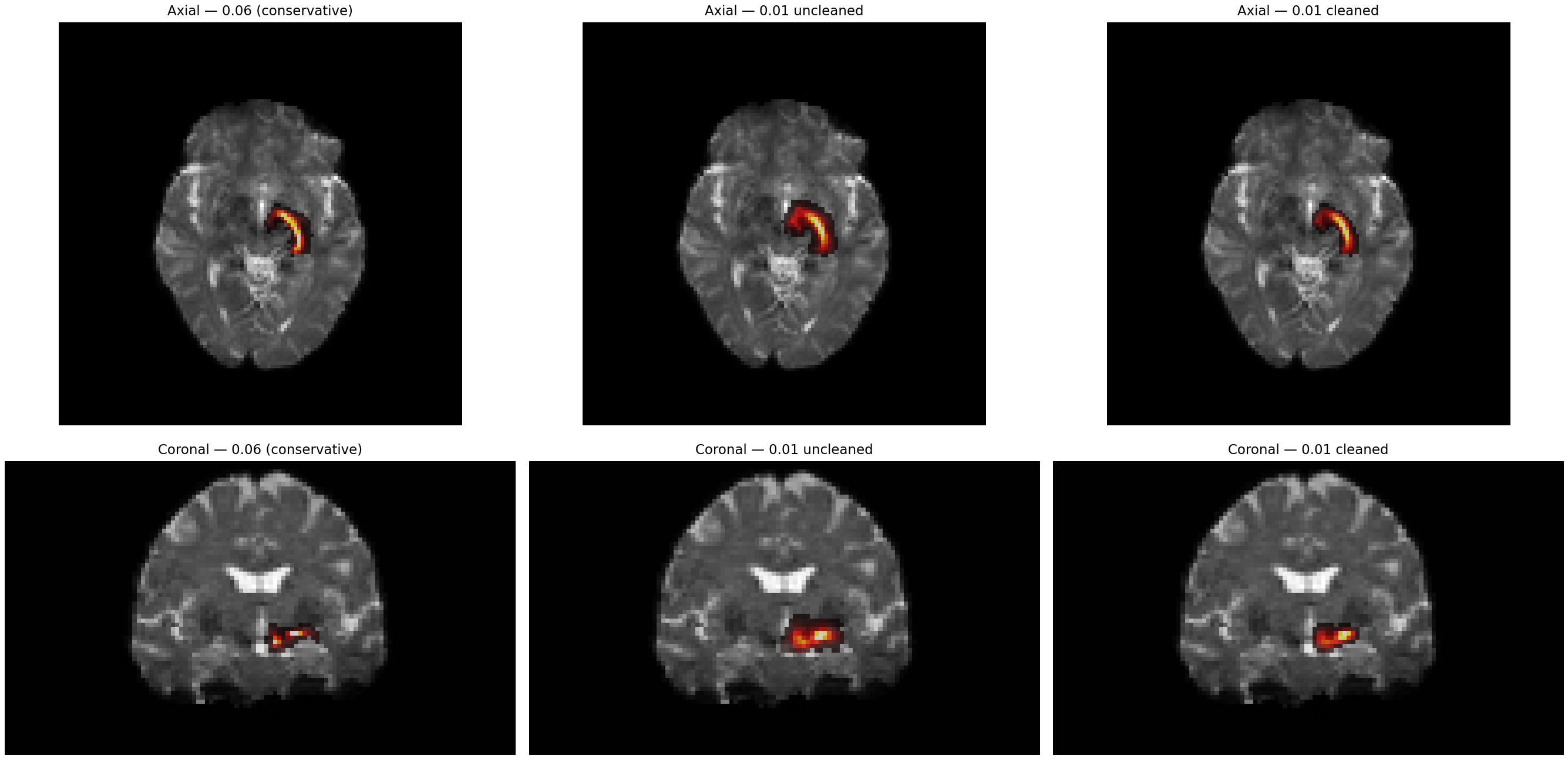
Note. Left: cutoff 0.06, uncleaned (1,000 streamlines). Middle: cutoff 0.01, uncleaned (2,500). Right: cutoff 0.01, cleaned (824). One participant, left posterior VTA → hippocampus. VTA = ventral tegmental area.
Figure 2
Standard Deviation of Streamline Length by Condition Across the Five Pilot Participants
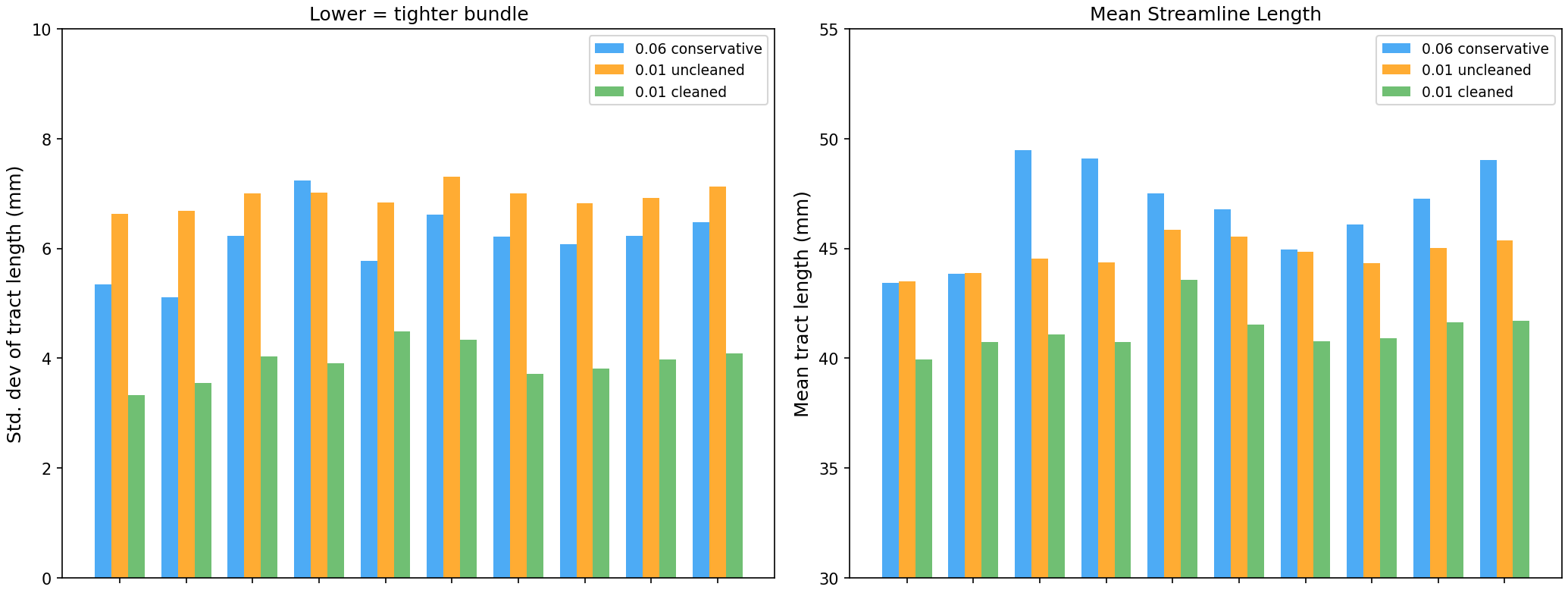
Note. Bars are grouped by pilot participant and hemisphere. Cleaned 0.01 in green.
Tracts with two bundles
Some tracts reconstruct as two distinct bundles rather than a single bundle with outliers. VTA → hippocampus has a ventral secondary bundle in a subset of participants, and hippocampus → nucleus accumbens → ventral pallidum frequently produces two bundles. Mahalanobis cleaning applied to such a mixture retains the wrong bundle or a blend. The procedure used during atlas construction clusters the streamlines with QuickBundles (Garyfallidis et al., 2012; threshold 5 mm, streamlines resampled to 100 points), cleans the two largest clusters separately, and retains the anatomically correct one after inspection. Setting QB_SPLIT = True in the script produces _cluster1_cleaned.tck and _cluster2_cleaned.tck per participant. The correct cluster is copied to <tract>_<cutoff>_cleaned.tck and the script is run again to rebuild the covariate table; the selection should be recorded per participant in the manifest. In the example dataset the corridor and cleaning were sufficient for VTA → hippocampus and the division was not required.
Verification
The cleaned file must exist and contain more than zero streamlines for every participant. Counts before and after cleaning and the retention percentage are reported; retention below 15% or above 80% warrants inspection. The script also writes $OUT/nodewise/<tract>_tract_stats.csv, which holds the streamline count and mean length of each cleaned bundle (Streamline_count, Mean_length_mm). Both index reconstruction quality, vary across participants, and are entered as covariates in Step 9.